Showing posts with label Aunt Carrie. Show all posts

Monday, August 17, 2020

Cabbage Salad.

Well, life flies by, things come up, and one's attention gets dragged away from blogs. Fortunately, the blogs stay and wait for our renewed attention. As long as we can remember the appropriate password for the account. Which I did, eventually.

Today, a warm day, I have a recipe for a cabbage salad from Aunt Carrie's recipe box. . It's a German type of salad, with a vinegar-sugar-oil boiled dressing. The card looks well-used; it must have been a favorite. Cabbage salads and coleslaws with non-mayo dressings are great for picnics or church potlucks where they can sit out longer than mayo-based salads, which go scary and bad quickly without refrigeration.

Aunt Carrie copied this recipe from the Mennonite Weekly Review, now called Mennonite World Review, a paper for Mennonites and Anabaptists in North America. Her note at the bottom, "She adds..." is, I think, a note from the submitter of the recipe. The recipe doesn't specify how much celery seed, salt and pepper to sprinkle on the vegetable layers...off the top of my head, I'd think maybe 1/2 tsp of celery seed and salt on each layer and 1/4 tsp pepper.

This recipe also has a whopping amount of sugar and I'm wondering if it would work to cut it by 1/3 or even 1/2. Todd and I love vinegary salads, so I'll have to try this with less sugar and see how it works.

Cabbage Salad  (Menn. Weekly Review)


1 sm head cabbage, shredded

1 sm onion, chopped
1 green pepper, chopped

1/2 cup salad oil
1/2 cup vinegar
1 cup sugar

Arrange cabbage, onion and pepper in bowl in layers, seasoning each layer with celery seed, salt and pepper.

Combine oil, vinegar and sugar and bring to a boil. Pour hot syrup over the cabbage mixture and let stand in refrigerator over night. Do not stir until the next morning.

She adds, This is the best cabbage salad I have ever eaten, it keeps well for several days.

Friday, September 28, 2018

Tomato Soup to Can.

It's been a fast-moving summer. Lots of company and traveling and other things. Though it's technically fall now that the autumnal equinox has come and gone, here in southeastern Virginia, it still feels pretty much like summer, and will for the foreseeable future, according to my weather app.

Regardless of the temperature outside, I have been craving tomato soup, and have indulged in it a few times the past couple of weeks. Just turn your thermostat down a degree or two, and light a spicy candle, and it's easy to pretend fall is nigh.

The cusp of fall is also a time when gardens are finishing up their tomato boom, and gardeners are frantically canning and freezing their bumper crops of various vegetables. I remember many steamy August days in our non-air-conditioned house with the pressure cooker running full blast on the stove as my dad and mom worked to preserve as much as they could for the colder months. (I helped with blanching and freezing things...I was less interested in learning the intricacies of the pressure cooker. I'm still so dubious about pressure cooking, I don't even use the Instant Pot I own.)

Aunt Carrie came from a long line of gardeners and knew well how to can her garden produce. Here we have three recipes for tomato soup made for canning. If you're afraid of pressure cookers like I am, these recipes all look like they could be frozen instead--after allowing the mixtures to cool, you could ladle them into freezer bags or boxes and pop them in the freezer.

All of these recipes are fairly similar. The first two call for a peck of tomatoes, which is a measurement of volume, not weight, and which is not used much any more except at farmer's markets. (I bought a half-peck of Autumn Crisp apples when I was in Ohio two weeks ago.) A Google search will send you down a rabbit hole of peck measurements of various types of produce...for our purposes, we will go with Yahoo Answers and say that a peck of tomatoes is roughly 13 pounds.

This first recipe also refers to cold pack canning...I did a cursory search on hot pack vs. cold pack canning and frankly, my eyes glazed over, so I won't attempt to address it here. If you're interested enough to read three recipes on tomato soup to can, I'm assuming you know the difference or can figure it out for yourself!

Tomato Soup to Can


1 peck tomatoes
2 stalks celery
6 onions
1 handful parsley

Cook--put through sieve. Put on stove, heat, add 1 cup sugar, 1/2 cup butter, 1/4 cup salt. Add 1 cup flour mixed with cold tomato sauce. Stir in till thickened. Put in jars and cold pack 20 minutes

-Shirley McDaniels

The next recipe looks like something Aunt Carrie clipped from her local newspaper when she lived in northwestern Pennsylvania. It specifies adding milk to the soup when serving to make more of a creamy soup. Yum!

Tomato Soup


1 peck tomatoes
3 large stalks celery
3 onions
1/8 cup salt
1/4 pound butter
1 cup sugar
1 cup flour
water

Cook tomatoes, celery, onions and salt. Put through sieve. Mix butter, sugar and flour, add enough water to make paste, add to tomato juice. Boil (careful not to let stick.) Pour into canning jars, put into a boiling bath. Process quarts for 20 minutes. To serve add 2 cups milk per quart.

This next recipe has the word "Budget" written next to the title--this does not mean it's a budget or economical recipe, but rather that Aunt Carrie found it in The Budget, an old and venerated newspaper that serves the Amish and conservative Mennonite communities of northeastern Ohio and beyond. You can subscribe to a national edition of The Budget for $48/year.

Of the three recipes, this one sounds the most appealing to me, probably because it has more flavor enhancers with the cloves, bay leaf, and celery salt. It also has much less sugar than the first two. You do need at least a little sugar with most tomato recipes, to cut the acidity and bring out the sweetness of the tomatoes, but 1 cup of sugar in the previous recipes sounded like a lot. On the flip side, this recipe calls for more fat, a full cup. I'm sure every cook had her own personal recipe back in the day.

I also enjoyed the direction "Cook until done." It always makes me panic a little when I see those words in an old recipe. Not helpful, lady cooks of the past! Not helpful at all!

Did you know that the # sign used to mean "pounds," not "hashtag"?? If you're over 40, you do! #tomatosoup #oldAF #loveyoumillenials

Homemade Tomato Soup 


14 pounds tomatoes
1/2 t. whole cloves
1 chopped green pepper
1 chopped onion
1 bay leaf
1/3 cup sugar
2 sticks margarine
2/3 cup flour
4 t. salt
2 t. celery salt

Combine tomatoes, onion, cloves, bay leaf and green pepper and cook until done. Place in colander. Combine sugar, margarine, flour and a small amount of water and add to tomato mixture. Add salt and celery salt and cook twenty minutes. Place into jars and seal.

Martha Unruh
Halstead, Kansas

Monday, July 9, 2018

Oatmeal cookies.


 My great-aunt Carrie's recipe box has a ton of recipes for oatmeal cookies and their various variations. And why not? Oatmeal cookies are delicious, and because oatmeal is good for you, you can kid yourself that eating a stack of them is a good dietary choice. I'm a big fan of the oatmeal cookie, with or without raisins, nuts, or chocolate chips or any combination thereof.

This first recipe is written in a different handwriting and labeled "Ruth," which leads me to believe it's from Carrie's sister-in-law, my great-aunt Ruth Shoup Weaver, who was married to Carrie's brother John. I knew Ruth slightly--she and my great-uncle John lived in the house where my Weaver great-grandparents had raised their family on Renkenberger Road outside Columbiana, Ohio. I distinctly remember going to the estate sale there when she and John moved out, because it sparked my lifelong love of estate sales and digging through other people's junk.Also, Mennonite estate sales used to be a great place to get pie by the slice, baked by all the church ladies to serve at the refreshment table. That sale may have been here I had my first taste of peach pie. A memory to savor!

Here are John and Ruth as I remember them.


And here's my great-grandparents' little farm--the house has been white for as long as I've ever known it, but apparently long ago it was a different color. Looks red to me, but I can't quite imagine my reserved Mennonite Weaver family painting a house red.


ANYWAY, oatmeal cookies. We've had a break in our hot humid July weather the past few days, and the thought of turning on the oven is almost not unbearable. So perhaps an oatmeal cookie and a glass of iced tea would be appealing today...care to join me?

Aunt Ruth's Oatmeal Cookies


1 cup shortening
1 cup sugar
1 cup raisins
2 cups oatmeal
2 eggs
2 cups flour
1 cup sour milk
salt, soda, cinnamon- 1 tsp. each

Bake at 350 degrees; makes about 5 dozen. Note: could add 1 cup chocolate chips.

The method of mixing is not included here, but with these kinds of cookies, you want to cream together the fat and sugar, and then mix in the eggs, raisins and oatmeal. Then I'd mix the dry ingredients together and add them alternately with the sour milk, which you can make by adding a splash of white vinegar to a scant cup of milk, if you don't have any milk that has soured on its own. No baking time is indicated here, but I find 10-12 minutes is a good guideline for cookies of this type, depending on how big you scoop them.

If you're like me, you buy bananas and you throw away bananas. Occasionally, you may eat one, but mostly it's just buy them and throw them away. It's frustrating! Sometimes I toss the over-ripe ones in the freezer, thus adding another step to the buying and throwing away process.

But every so often I get the energy to use up some bananas, so if you have a few on the counter and some spare energy, consider a banana oatmeal cookie.

Banana Oatmeal Cookies


1 1/2 cups sifted flour
1 cup sugar
1/2 t. baking soda
1/4 t. ground nutmeg
1 t. salt
3/4 t. ground cinnamon
3/4 c. shortening
1 egg well beaten
1 cup mashed ripe bananas (2 or 3 bananas.) Use fully ripe ones.
1 3/4 cups rolled quick-cooking oats
1/2 cup chopped nuts

Sift together the flour, sugar, soda, salt, nutmeg and cinnamon into mixing bowl. Cut in shortening.

Add egg, bananas, rolled oats and nuts. Beat until thoroughly blended. Drop by teaspoonfuls, about 1 1/2 inch apart, into greased cookie pans. Bake in a moderately hot oven (400 degrees) for about 15 minutes or until cookies are done. Remove from pan immediately.

This recipe was clipped from a newspaper, one from the area where Aunt Carrie grew up (and I did, too) in northeast Ohio. Leetonia is the small town where my husband grew up and where he and I both attended high school. I think the submitter, Mrs. Ervin Miller, may have been a conservative Mennonite wife from one of the farms around Leetonia.

Tuesday, July 3, 2018

Red Raspberry Salad.

I've been wanting to recreate one of Aunt Carrie's recipes and finally got some time after dinner this evening. This is one of the tastier-sounding ones, a raspberry Jello "salad" clipped from the newspaper and pasted to a 3x5" card.


Red Raspberry Salad

1 package raspberry or strawberry gelatin
1 cup boiling water
1 cup applesauce
1 package frozen raspberries or strawberries
1 cup sour cream
1 cup miniature marshmallows

Dissolve gelatin in boiling water. Add applesauce and frozen fruit. When softened, let set until firm.

Combine sour cream and marshmallows, and let set for one hour. Whip with electric mixer, then spread over chilled gelatin. Let set overnight.


As is the case with many older recipes, there's a frustrating vagueness here. What size Jello package? What size frozen fruit package? What size pan to put it all in, for that matter?

Looking at the other ingredient amounts given, I figured that the package of Jello called for was the standard 3-ounce size, and that the pan would probably be an 8x8" dish. I don't know what the size of the frozen fruit package would have been...I seem to recall seeing fruit sold in 10-ounce packages years ago, but the small sizes seem to have gone away.

I am notorious for being a recipe tweaker, meaning I can never make a recipe exactly the way it's written. I usually think I know better--and in all modesty, I am usually right! But I decided to make this exactly as written....with one change. Not a big one! I just doubled it. So: a 6-ounce package of Jello (with Ironman on the front because apparently the Avengers are selling Jello now), a 16-ounce package of fruit because that seems to be the standard size now, and I poured it into an attractive white oval dish I have that is roughly equivalent to a 9x13" pan. Doubled, the ingredients are:

1 6-ounce package of raspberry or strawberry Jello
2 cups boiling water.
2 cups applesauce (I used unsweetened)
1 16-ounce package frozen raspberries or strawberries
2 cups (16-oz container) sour cream (I used reduced-fat)
2 cups miniature marshmallows

I chose raspberries (and raspberry Jello) because I love them just a little more than I love strawberries (but not by much.) My grocery store also had a mixed bag of strawberries, blueberries, blackberries, and raspberries that would make an amazing dessert, but I was trying to stick to the recipe (for once.)


The topping for this dish is a little weird. I've looked at many vintage Jello "salad" recipes, and I truly have never seen a topping of marshmallows dissolved and whipped in sour cream. I thought it sounded intriguing. You need to let the mixture sit for at least an hour before whipping it with the mixer, so the marshmallows can break down. I was impatient and so there are some small lumps of marshmallow in my topping, but they may dissolve completely as it sits in the fridge overnight. We'll try this for our Fourth of July lunch tomorrow and I'll update the taste test then.

I think some finely chopped pecans or pistachios would look lovely scattered across the topping. I might add those later.

UPDATE: We enjoyed some raspberry salad after a hot day outside on the Fourth of July. I kept expecting the sour cream/marshmallow mixture to taste like Cool Whip for some reason, but after my taste buds adjusted, I found it enjoyable. The marshmallows sweetened the sour cream slightly, but it remained tangy, and was a nice contrast to the sweet Jello. My husband said it was "delicious and refreshing," and also "a little seedy." Which was true--we don't eat seeded fruits like raspberries too often even though I do love them. (I have a little diverticulitis problem.) I didn't find the raspberry seeds too obtrusive, though. We would recommend it for a hot summer day!

Monday, June 25, 2018

Scary salads.

Aunt Carrie's recipe box has a number of salad recipes, heavy on the coleslaw and jello salads, and I'll share some of those later, but these two stand out for two reasons: they have just a list of ingredients, no real instructions, and they sound slightly horrifying.

Home economists in the early twentieth-century liked to come up with strange combinations of chopped fruits and vegetables, bound together with that processed food innovation, salad dressing. Miracle Whip was the most famous of these, a sweeter version of mayonnaise, and both began to appear ready-made in jars at about the same time. In my home growing up, we called Miracle Whip "mayo" and used it exclusively on our sandwiches and in our tuna salads. When I grew up and got my own home, I developed a distaste for Miracle Whip and came to love Hellmann's mayonnaise. My husband still prefers the "tangy zip" of Miracle Whip (to quote an old commercial) and so I keep a small jar of each for us in the fridge, in the reduced-fat versions.

Feel free to use either, should you decide to tackle one of these salads.

Salad

When I scanned this one, I wasn't even sure how to label it since it didn't really have a title, so I labeled it "Yukky Salad." (Of course then I couldn't remember what the label was when I went to find it just now.)

The card reads "Salad - Ebersoles," who must have been a family Aunt Carrie knew, maybe from church. No quantities are specified, just a list of ingredients seemingly pulled at random from one's pantry and fridge.


Carrots
Bananas
Marshmallows
Peanut Butter
Celery
-----Mayonnaise--

Odd as it is, this is a somewhat typical "salad" recipe of the kind I mentioned above. The only ingredient that looks unfamiliar to me is the peanut butter. Bananas and marshmallows, in particular, were beloved in the 1920s and 1930s as treats that went well with chopped salads and Jello salads. Bananas were tropical and exotic, and marshmallows were a novelty. I would assume here that one grates the carrots, dices the bananas and celery, and mixes all the ingredients together with a little mayonnaise dolloped on at the end, either to help bind it or as a garnish on top. Let's move on, shall we?

Carrot Salad

Salads based on grated carrots have been around for a long time. I remember my mom making a Jello salad with grated carrots and crushed pineapple suspended in orange Jello, and it was darned tasty. There's also a grated carrot salad with raisins and a sweet mayo-based dressing in one of the Barefoot Contessa cookbooks, as Ina Garten, the author, likes to delve back into the retro recipes of her youth from time to time.

Aunt Carrie notes "Radio" as the source for this salad, probably one of the many homemaker programs that were on the radio for decades in the mid-twentieth-century.


2 cups grated carrots
1/4 cup shredded coconut
1/2 cup red apples diced
1/4 cup canned pineapple cubes
Enough mayonnaise to moisten.

Honestly, I would eat this. I might squirt a little lemon juice on it to brighten up the taste and keep the apple chunks from browning. Plain or vanilla yogurt to replace the mayonnaise would probably be an excellent and much more modern taste for this salad. Not something you'd want to eat every day, but a good way to get some vitamins and fiber in the wintertime, when fresh fruits and vegetables used to be a lot harder to come by.

Monday, June 18, 2018

For hungry babies...and hungry baby pigs.

This is my great-aunt Carrie's recipe box. It's a carved wooden box that she bought from Ten Thousand Villages, a group of shops begun by a Mennonite woman to sell the works of artisans in poor countries here in the United States. This particular box was made in India.

Carrie Elizabeth Weaver Morris was born in 1916 and died in 2011. She was my grandma's older sister. I didn't know her well, but saw her every couple of years when she and her husband would come to visit my grandparents or at family reunions. When Carrie went into a nursing home a number of years before she died, she gave a few of her belongings to my grandma, who spread them out on her kitchen table and invited some of us assorted family members to take what we wanted. I picked up the box.

The recipes in the box cover a wide span of years, I think. The most recent date on a card is 1993. The oldest look to be at least 30 years older than that. Some of them are very well-used, others look cleaner though yellowed with time.

I suspect that this wasn't Carrie's only recipe repository. If she was at all like me, she had cards and papers and cookbooks and maybe even a folder or binder or two, scattered in various spots in and near the kitchen. The recipes are heavy on cookies and desserts, lighter on meats and salads, and full of interesting oddities. I thought I'd kick things off with two of the more amusing ones.

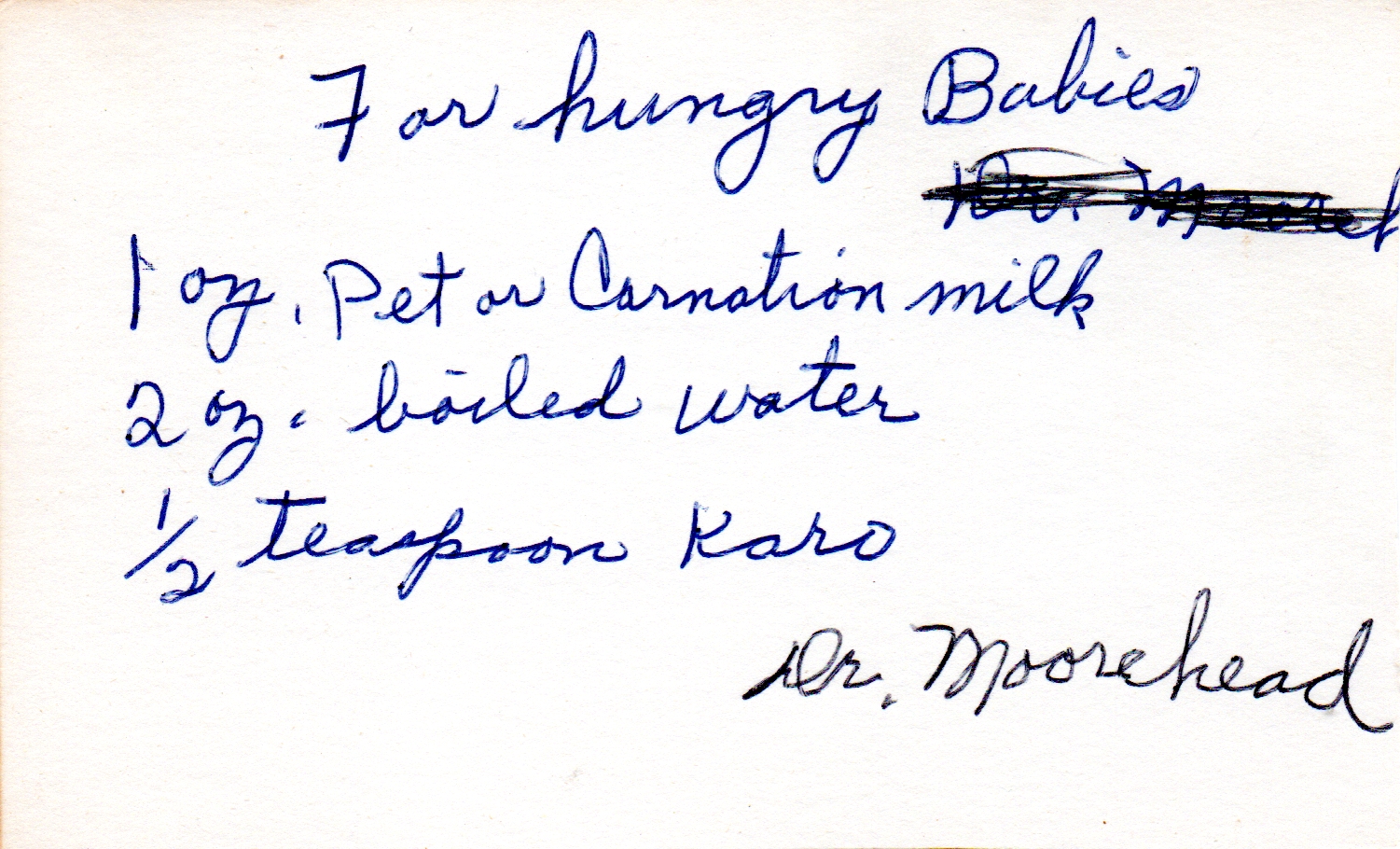
For Hungry Babies:


1 oz. Pet or Carnation milk
2 oz. boiled water
1/2 teaspoon Karo

-Dr. Moorehead

I think Carrie may have longed for children much of her life. She married at age 38, and for whatever reason, the babies did not come. In middle age, she and her husband Paul adopted a little boy named John, but he was early toddler age when they adopted him, so probably would not have needed formula. Carrie may have written down this recipe to use for her many nieces and nephews when she went to help their mothers after the latest baby arrived.

This looks like a fairly common baby formula recipe from the post-war era...Pet and Carnation are brands of evaporated milk, and Karo is a corn syrup brand. I think most of us would hesitate to give a baby corn syrup nowadays!

Feeding Baby Pigs by Dr. Barber


1 part cow's milk
3 parts boiled water
1 tablespoon sugar
1 tablespoon lime water, to make a pint.

Feed every 2 or 3 hours for several days.

Carrie and Grandma grew up on a small farm in Ohio, and most family farms had at least a pig or two for meat. Carrie lived at home most of the time until she married, so she may have fed any number of squirming baby pigs. I've never fed a pig, but it seems like it would be difficult!

Here's Aunt Carrie with her siblings in 1966. From left to right, Martha Weaver Martin (my grandma), Carrie Weaver Morris, Edna Weaver Zook, and John Weaver.